
In Week 44, container prices in China are moving upward across three key segments: new containers, used containers, and container leasing. This is more than a series of isolated price adjustments. The market is seeing upward pressure across manufacturing, secondary sales, and equipment leasing.
HYSUN’s assessment is that the main issue is not an overall shortage of containers, but a mismatch between supply and demand by container type, location, and timing.
At major container pickup locations across China, including Shanghai, Xiamen, Chengdu, and Xi’an, availability remains tight for certain types of equipment. Buyers are not simply looking for any container. They need the right type, at the right depot, at the right time.
Port congestion is slowing the return and repositioning of empty containers. Meanwhile, shipping lines tend to prioritize equipment allocation for customers with long-term contracts, making it more difficult for smaller freight forwarders to secure the boxes they need. As a result, both procurement costs and the time required to arrange equipment are increasing.
In the short term, new container production schedules extending into November suggest that additional supply may remain limited. This is likely to provide some support for used container prices and leasing rates. However, the market may begin to ease around the time new containers are delivered in November, particularly if seasonal cargo demand weakens. Any improvement in availability will depend on actual deliveries and the pace of demand.
1. New Containers: Production Slots Are Tight, Keeping Prices Firm
New container prices are moving from a period of recovery toward a firmer market.
According to market information cited in recent industry updates, orders at China International Marine Containers (CIMC) have been scheduled through November, while prices have continued to improve month on month. Market feedback suggests that securing production slots is becoming increasingly difficult, even for buyers willing to pay higher prices.
The current increase appears to be driven less by a sudden surge in demand than by full production schedules and support from steel and other manufacturing costs.
When production capacity is heavily booked, manufacturers have less room to offer discounts, particularly for buyers who require prompt delivery. For customers planning new container purchases, production lead times are therefore becoming just as important as the quoted unit price.
2. Used Containers: China Remains a Firm Market
Used container prices in China have climbed substantially and remain at elevated levels.
China is among the firmer markets for used containers, although prices vary considerably depending on equipment condition, container type, and pickup location.
It is important to distinguish between a broad upward trend and a uniform price increase. The current market strength is most evident in cargo-worthy containers and popular equipment types available at major pickup locations. It does not mean that every used container, regardless of age or condition, has increased in price to the same extent.
For buyers, comparing quotations on a like-for-like basis is essential. Container condition, inspection standards, depot location, and availability can all affect the final cost.
A lower quoted price may not necessarily represent a better deal if the container requires additional repairs or must be repositioned over a long distance.
3. Container Leasing: Short-Term Equipment Costs Are Rising
Leasing rates are also trending upward, particularly for equipment used on routes serving Europe, Central Asia, and Russia. The Russian market has reportedly seen the most pronounced increases.
The cost pressure follows a relatively straightforward chain: higher equipment costs for container owners can lead to higher leasing rates for shipping lines and other equipment users. These increases may eventually be passed on to customers, depending on contract terms and market conditions.
Leasing remains a practical option for businesses with temporary or short-term equipment requirements. It offers flexibility without requiring a long-term commitment to purchasing containers.
However, the availability of low-cost equipment is becoming more limited in some locations. Buyers and operators should therefore evaluate not only the daily or monthly rental rate, but also the lease duration, pickup arrangements, repositioning costs, and return conditions.
4. HYSUN’s Recommendations: Plan Ahead and Compare the Total Cost
Given the current market conditions, HYSUN recommends the following measures for buyers and container users.
Secure equipment early. Where possible, arrange container availability 7–10 days before the planned pickup date. This allows more time to confirm stock, coordinate logistics, and compare alternatives.
Include repositioning costs in your budget. A container’s purchase or rental price is only part of the total cost. Inland transportation, depot handling, and the cost of moving equipment to the required location can materially affect the final quotation.
Match lease terms to your actual requirements. For leasing customers, the timing of new container deliveries and the expected duration of equipment use should be considered together. Avoid committing to unnecessarily long leases at elevated rates when shorter arrangements may meet your needs.
Confirm availability before making a commitment. Market quotations can change quickly, and equipment availability varies by location and specification. Buyers should confirm the latest price, condition, delivery schedule, and pickup point before placing an order.
Outlook: Will Container Prices Continue to Rise?
The direction of the market will depend on how quickly new containers are delivered, whether empty equipment can return to circulation more efficiently, and how cargo demand develops in the coming weeks.
For now, tight availability at specific pickup locations and limited near-term supply are supporting prices. November deliveries could ease some of the pressure, but a broad market correction should not be assumed without clearer evidence of improving availability and softer demand.
For buyers, the key question is no longer simply whether container prices are rising. It is whether the required equipment can be secured at the right location, within the required timeframe, and at a reasonable total cost.
Data sources: CIMC industry information, Sina Finance research reports, HARPEX, and publicly available market quotations. Market observations and forecasts are indicative only. Actual prices and availability vary by container type, condition, location, and transaction terms. This article is for informational purposes only and does not constitute purchasing or investment advice.
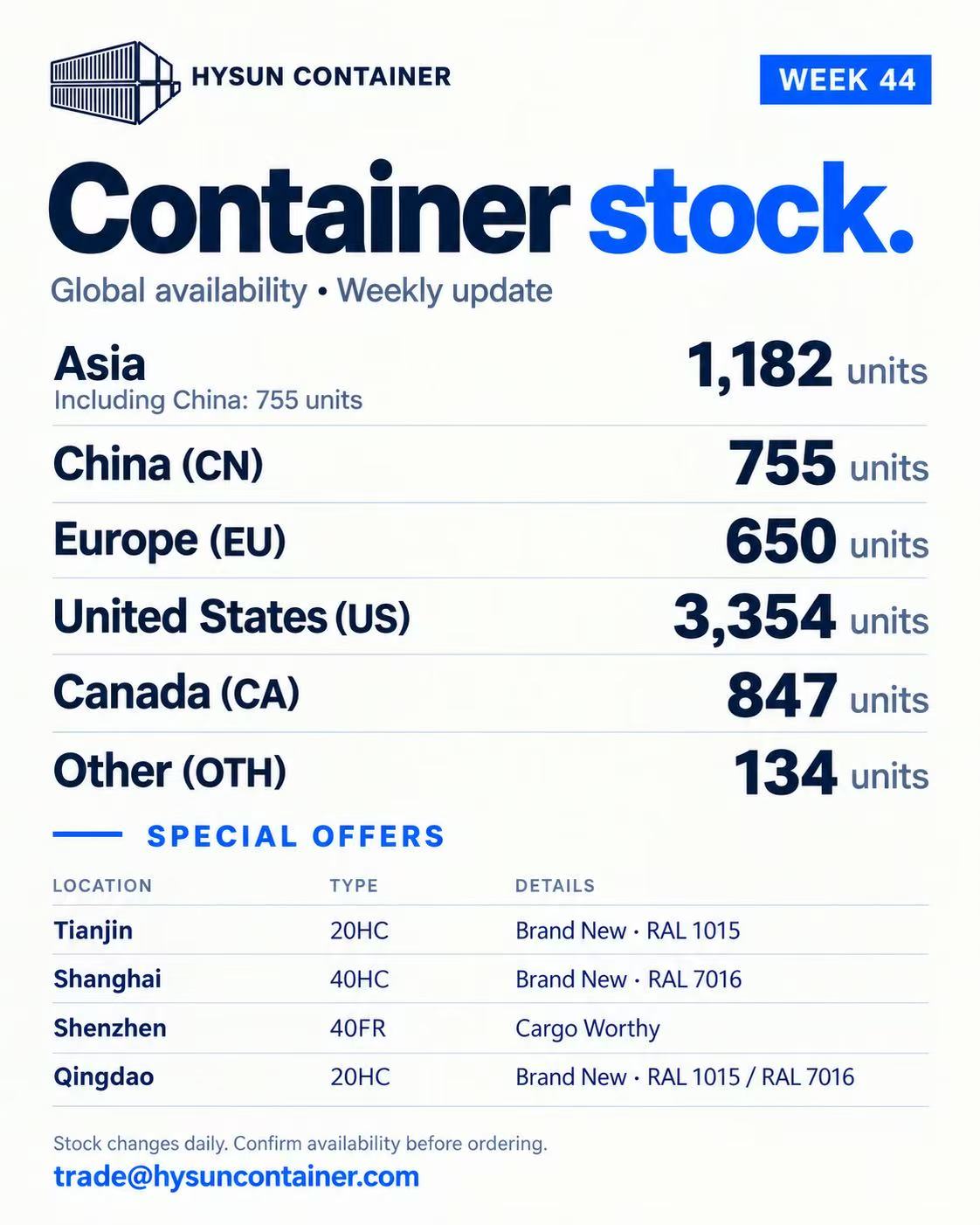
HYSUN’s Week 42 inventory update covers container availability across Asia, Europe, the United States and Canada, with selected special offers. Stock changes daily—contact us with your required container type, condition, quantity and pickup location for the latest availability and pricing.
Hysun Inventory list in 43 week: